




RBA Hold Weighs on AUD While Oil Eases on Output Recovery | 9th December 2025


Aussie Drops After RBA
Global markets opened mixed as Australia’s central bank held interest rates steady at 3.6%, pressuring the Australian Dollar across major pairs. The RBA’s neutral tone weighed on AUD/USD, AUD/NZD, and AUD/JPY, with traders scaling back expectations for any near-term tightening. Meanwhile, oil prices slipped, with WTI retreating toward $58.50 following the recovery of Iraq’s oilfields, easing supply concerns. In North America, USD/CAD maintained a slight downside bias, though losses were limited by renewed US tariff concerns under Trump’s comments. Overall, the session is dominated by RBA-driven currency moves and shifting energy market sentiment.
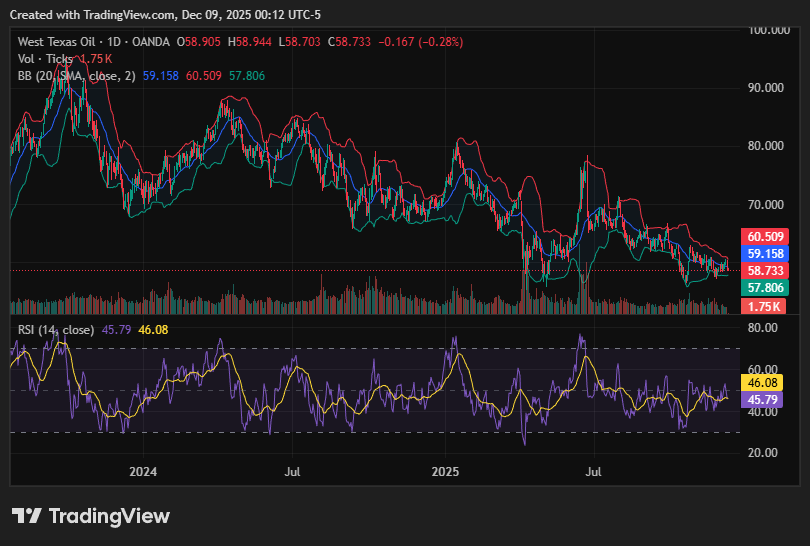
WTI Crude Oil Forecast
Current Price and Context
WTI is trading near USD 58.50/barrel as supply-side optimism from Iraq’s oilfield recovery weighs on prices, while oversupply concerns linger globally.
Key Drivers
Geopolitical Risks: Recovery in Iraqi oil output increases supply, pressuring WTI.
US Economic Data: Soft US data and expectations of lower US interest rates tend to weaken the dollar, which could support oil — but current oversupply worries dominate.
FOMC Outcome: Anticipated rate cuts by Federal Reserve (Fed) could dampen USD and support oil demand, though mixed signals keep sentiment murky.
Trade Policy: Global trade/tension risks — such as US-China trade uncertainties or sanctions — affect demand expectations for crude and could support oil if supply risks emerge.
Monetary Policy: Lower global interest rates tend to support commodities like oil, but persistent supply concerns still weigh heavily on WTI.
Technical Outlook
Trend: Mildly bearish/neutral — WTI trades just below $60 after a short-term rally, but limited upside remains.
Resistance: Around $60.80–$61.50 (near recent highs before the pullback).
Support: Near $57.50–$58.00 (recent bottoms and oversupply pressure zones).
Forecast: Unless a major supply disruption emerges or global demand outlook improves, WTI could remain in a $57.50–$60.50 range in the near term.
Sentiment and Catalysts
Market Sentiment: Cautiously bearish — traders are wary about oversupply despite some supportive factors (rate cuts, potential supply shocks).
Catalysts: Upcoming US crude inventory reports (API / EIA), developments in Iraq and OPEC+ production plans, and global demand signals (e.g. China demand, US economic data).
AUD/USD Forecast
Current Price and Context
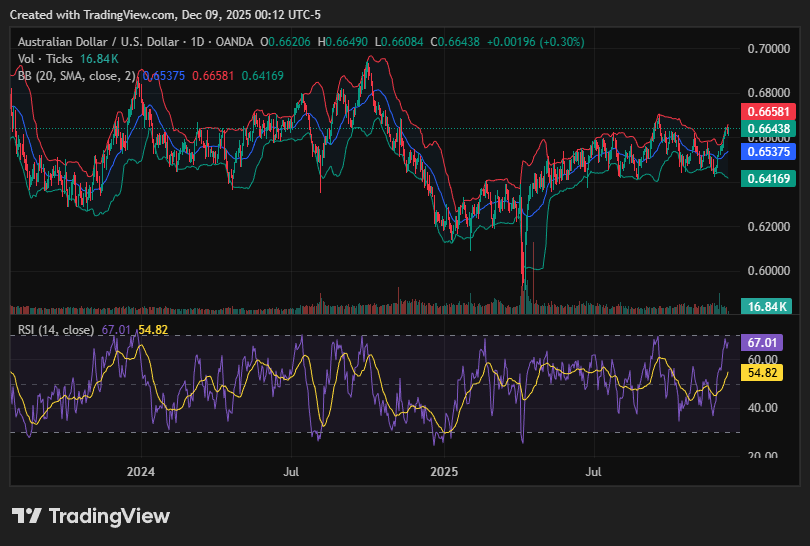
AUD/USD is trading around 0.6625–0.6640, drifting slightly lower after the Reserve Bank of Australia (RBA) kept its OCR at 3.60%. The Aussie remains supported, however, by diverging expectations between a steady/hawkish RBA and a potentially dovish Fed.
Key Drivers
Geopolitical Risks: Global risk sentiment affects commodity-linked currencies like AUD; safe-haven demand or risk-off moves could pressure AUD.
US Economic Data: Weak US data and expected Fed rate cuts tend to push USD lower, helping AUD/USD.
FOMC Outcome: A dovish Fed decision would likely weigh on USD and support the Aussie.Trade Policy: Global growth and trade demand — especially in China (a key trading partner) — influence AUD via commodity demand.
Monetary Policy: RBA’s decision to hold at 3.60% and hint at possible tightening supports the AUD, as market pricing shifts away from additional rate cuts.
Technical Outlook
Trend: Moderately bullish — price remains above the 20-day EMA, and consolidation after recent gains suggests potential for continuation
Resistance: Near 0.6650–0.6680 (recent highs / multi-week peaks).
Support: Around 0.6600–0.6570, with deeper support near 0.6540–0.6535 (50-day / 100-day SMA area).
Forecast: If RBA maintains hawkish-tilt and the Fed signals cuts, AUD/USD could test 0.6650–0.6680; weakness below 0.6600 may test support toward ~0.6530.
Sentiment and Catalysts
Market Sentiment: Neutral-to-bullish — traders remain open to further AUD upside but are cautious ahead of RBA’s detailed communications.
Catalysts: RBA press conference comments, upcoming US data (employment, CPI), and Fed decision; also global risk sentiment.
USD/CAD Forecast
Current Price and Context
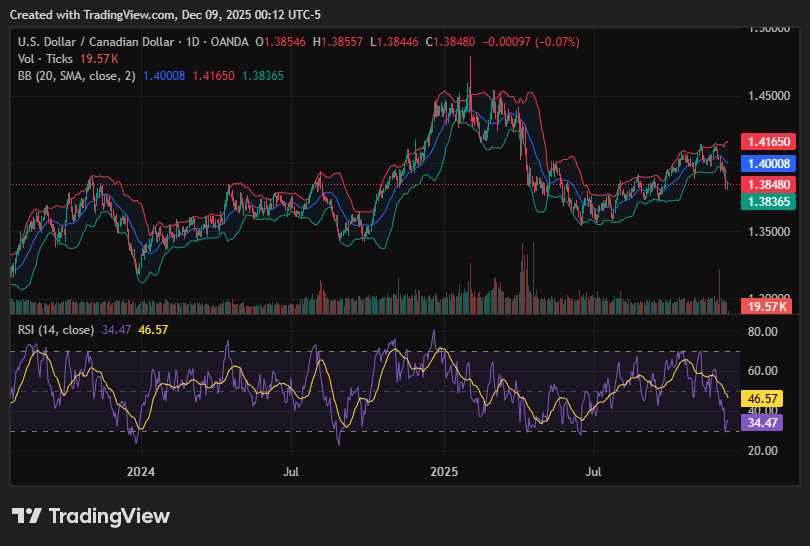
USD/CAD is trading in the mid-1.3800s, showing a negative bias as the Canadian dollar gains modest strength. However, losses remain limited amid US tariff-related uncertainty and global risk factors.
Key Drivers
Geopolitical Risks: Tariff threats and trade tensions — especially related to US policy — can influence USD/CAD volatility.
US Economic Data: Strong US data could boost USD, pushing USD/CAD higher; weak data supports CAD.
FOMC Outcome: A dovish Fed would weigh on USD, benefiting CAD and pushing USD/CAD lower.
Trade Policy: Energy and commodity demand (oil prices) matter for CAD. Weaker oil tends to pressure CAD, but stable oil helps.
Monetary Policy: Diverging monetary stances between USD and CAD, along with global interest rate cues, provide directional bias.
Technical Outlook
Trend: Slightly bearish to neutral — limited downside as support levels hover, but no strong bullish reversal yet.
Resistance: Around 1.3850–1.3880 (recent intraday highs).
Support: Near 1.3750–1.3700, where previous declines found buying interest.
Forecast: If USD weakens and oil remains stable, USD/CAD could drift toward 1.3700–1.3750; a strong USD or oil-price rebound could reverse toward 1.3850+.
Sentiment and Catalysts
Market Sentiment: Cautiously bearish — traders are leaning toward modest CAD strength but remain alert for USD or oil-driven reversals.
Catalysts: US tariff developments, US economic data releases, oil price movements, and any signals from US or Canadian central bank policy.
AUD/NZD Forecast
Current Price and Context
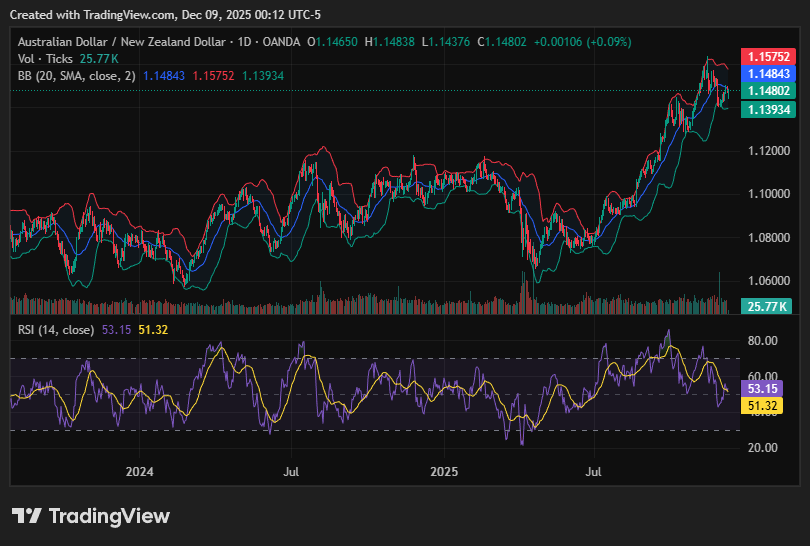
AUD/NZD has slid toward ~1.1440 after the RBA kept its OCR unchanged at 3.6%, dampening AUD strength vs other major currencies like NZD.
Key Drivers
Geopolitical Risks: Global risk sentiment affects both AUD and NZD; any risk-off may push AUD/NZD lower if AUD underperforms.
US Economic Data: Indirect effect via USD strength/weakness on commodity currencies.
FOMC Outcome: A weaker USD post-Fed could buoy both AUD and NZD, but relative strength depends on local central banks.
Trade Policy: Commodity demand and trade flows for Australia and New Zealand influence cross-rate dynamics.
Monetary Policy: RBA’s neutral stance reduces AUD’s edge; if NZ’s policy outlook appears more hawkish (or stable), NZD can outperform — weighing on AUD/NZD.
Technical Outlook
Trend: Short-term bearish as AUD loses momentum vs NZD after the RBA decision.
Resistance: Around 1.1550–1.1600 (recent range highs).
Support: Near 1.1400–1.1420, current trading area; further support might come around 1.1350 if downside continues.
Forecast: Unless AUD gets a hawkish surprise or NZD weakens, expect AUD/NZD to test 1.1400–1.1350 in the near term.
Sentiment and Catalysts
Market Sentiment: Slightly bearish toward AUD vs NZD — investors are pricing in AUD weakness after the RBA hold.
Catalysts: RBA post-meeting tone, NZ domestic data or central bank signals, global risk sentiment shifts, commodity-market news.
AUD/JPY Forecast
Current Price and Context
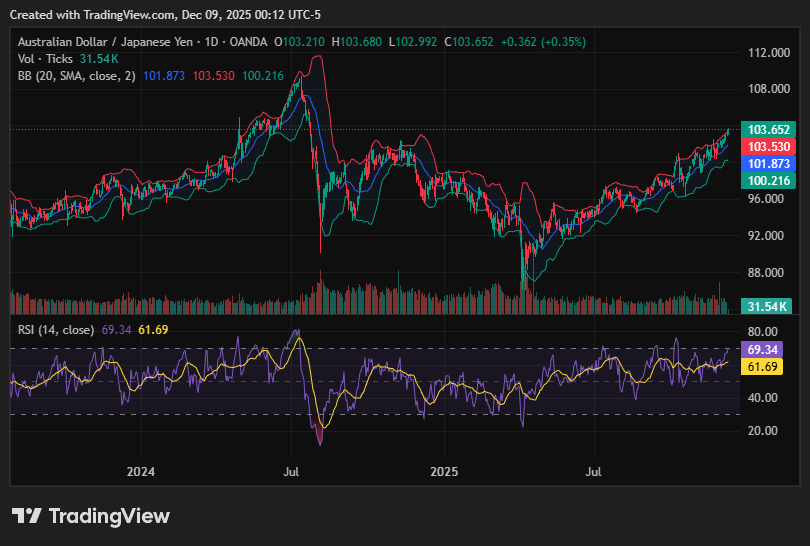
AUD/JPY has weakened below 103.50 after the RBA’s decision to hold rates at 3.6%, softening AUD strength relative to the yen.
Key Drivers
Geopolitical Risks: Risk sentiment and safe-haven flows impact AUD/JPY — risk-off tends to benefit JPY, hurting AUD/JPY.
US Economic Data: Influences global USD moves, which indirectly affect cross-rate dynamics including AUD/JPY.
FOMC Outcome: A weaker USD post-rate cut could lift JPY and compress AUD/JPY further; dovish Fed tends to support JPY strength.
Trade Policy: Global trade demand and commodity prices influence AUD; any weakness in those dims AUD/JPY.
Monetary Policy: RBA’s neutral stance reduces AUD support; if the Bank of Japan (BoJ) or JPY-friendly policies gain traction, JPY may strengthen.
Technical Outlook
Trend: Bearish-to-neutral short term as AUD loses ground vs JPY after RBA statement.
Resistance: Near 104.50–105.00 (recent swing highs).
Support: Around 102.50–103.00 (psychological and technical support zones).
Forecast: Given current backdrop, AUD/JPY may drift toward 102.50–103.00, unless risk sentiment improves or AUD gets fresh support.
Sentiment and Catalysts
Market Sentiment: Cautiously bearish — investors reacting to RBA hold and positioning for potential JPY safe-haven flows.
Catalysts: RBA and BoJ communications, global risk events (geopolitics, market stress), commodity and trade-data flows.
Wrap-up
Currency markets remain focused on the RBA’s policy stance, which continues to exert broad pressure on the Aussie across the board. The Canadian Dollar sees modest support, while oil prices retreat on improving supply conditions. With central bank expectations and geopolitical risks still in play, volatility may pick up as traders await key US, Australian, and Canadian data releases. The broader tone remains cautious as markets digest the RBA’s decision and recalibrate expectations heading into midweek trading.
Ready to trade global markets with confidence? Join Moneta Markets today and unlock 1000+ instruments, ultra-fast execution, ECN spreads from 0.0 pips, and more! Start now with Moneta Markets!


The dollar is vulnerable to shocks

The dollar awaits the rate forecast

Markets Lifted by Fed Cut Hopes as Gold Surges; Yen Strengthens, Commodity FX Mixed | 8th December 2025

Markets Steady Ahead of Crucial US PCE Inflation Data | 5th December 2025

Dollar Mixed as Yen Strengthens and AUD Gains on Trade Momentum | 4th December 2025

DNA Markets - Daily Fundamental Analysis Report, 4 December

The dollar is weakening, as set by seasonality