-1162026812.png)
-1162026812.png)





A Defining Moment for US Monetary Policy

Tomorrow's Federal Reserve meeting has evolved into one of the most significant macro events of the year. Although the consensus expectation remains for interest rates to be left unchanged, market pricing has shifted materially over recent days. The implied probability of a 25-basis-point rate increase has risen to approximately 38%, compared with just 16% a week earlier, illustrating how rapidly expectations have been repriced. Even if the Federal Reserve ultimately leaves policy unchanged, the market has already begun adjusting to the possibility of a more restrictive policy stance. The repricing itself is now driving cross-asset performance ahead of the decision.
The US dollar has been the principal beneficiary of this changing narrative. Treasury yields have moved higher, the dollar has strengthened to one-month highs, and demand for dollar-denominated assets has increased as investors seek both higher yields and relative safety. This reflects a reassessment of the monetary policy outlook rather than a meaningful change in the underlying economic fundamentals. As is often the case, financial markets price expectations well before central banks deliver their decisions. Consequently, currencies, precious metals, equities and digital assets have all begun adjusting to a potentially more hawkish Federal Reserve.
Should the Federal Reserve leave interest rates unchanged while maintaining a distinctly hawkish tone, the dollar is likely to remain well supported. Such an outcome would reinforce the view that policymakers remain prepared to tighten policy further should inflationary pressures prove more persistent than anticipated. Under this scenario, US equities may remain under pressure, gold could struggle to regain upward momentum, and EUR/USD may continue to trade on the defensive. Volatility is therefore expected to remain elevated as markets continue to reassess the likely trajectory of US monetary policy.
A surprise increase in the federal funds rate would represent a genuine policy shock. Such a decision would fundamentally challenge the prevailing assumption that the tightening cycle has effectively concluded and would almost certainly trigger a broad repricing across global financial markets. The US dollar would be expected to extend its advance, Treasury yields would likely rise further, while equities, precious metals and cryptocurrencies could experience renewed selling pressure. More importantly, such a move would alter the broader perception of the global interest-rate cycle and significantly reshape investor expectations for monetary policy over the coming quarters.
Conversely, if the Federal Reserve adopts a more balanced tone and refrains from signaling an imminent resumption of tightening, markets could witness a relief rally. The dollar may surrender part of its recent gains as investors reduce defensive positioning, while risk-sensitive assets could recover on improving sentiment. Nevertheless, any recovery would remain conditional upon incoming macroeconomic data, particularly inflation and labor market indicators. The policy outlook beyond this meeting will continue to depend on evidence rather than guidance alone.
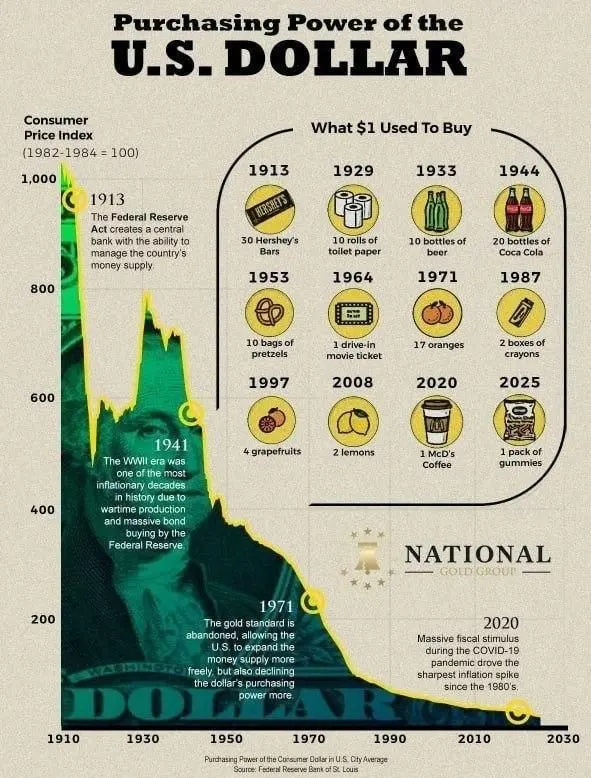
From a longer-term perspective, tomorrow's decision also highlights the broader evolution of the US dollar's purchasing power. Since the creation of the Federal Reserve in 1913, inflation has progressively reduced the currency's real purchasing power, despite the dollar retaining its status as the world's primary reserve currency. Periods of monetary tightening are designed to preserve price stability and contain future inflation rather than reverse the cumulative effects of more than a century of monetary expansion. Consequently, tomorrow's announcement is likely to influence not only near-term market direction but also investors' confidence in the future credibility of US monetary policy and the longer-term outlook for the dollar itself.


DXY Double-Top Breakdown Faces a Critical U.S. Labor-Market Test

August 4, 2026: S&P 500 Rally, Yen After Intervention, and Oil After the Crash

Equities Focus on Key Earnings After Consecutive Rallies

Weekly Technical Outlook – USD/JPY, EUR/USD, GOLD

Weekly Technical Outlook – USDJPY, EURUSD, GOLD

Forex and Crypto Forecast: August 3–7, 2026

EUR/USD: Busy Week Ahead