




Risk Management Basics for New Prop Traders
Risk management is the single most important skill for any new prop trader. In proprietary trading, you are not rewarded for taking risk—you are rewarded for controlling it.
Many traders with profitable strategies fail prop firm accounts simply because their risk management does not align with strict rules. This guide covers the core risk management principles every new prop trader must understand.
Why risk management matters more in prop trading
In prop trading, losses are capped by firm rules, not by your own comfort level. Daily drawdown limits, maximum loss rules, and consistency requirements leave very little room for error.
A single oversized trade can end an account—even if your strategy is statistically profitable. That’s why risk management is not optional; it is the foundation of survival.
Understand drawdown before placing your first trade
Every prop trader must clearly understand how drawdown works. This includes daily loss limits, maximum drawdown, and whether rules are based on balance or equity.
If drawdown mechanics are not crystal clear to you, review daily drawdown vs max drawdown before trading live.
Most failed prop accounts are not the result of bad strategies, but of traders accidentally violating drawdown rules.
Position sizing: the core of risk control
Position sizing determines how much damage a single trade can do. New prop traders often size positions based on potential profit instead of maximum acceptable loss.
Your position size should be small enough that even a losing streak cannot threaten your daily or total drawdown. If you’re unsure how to calculate this properly, review position sizing basics.
Consistent, controlled risk beats aggressive sizing every time in prop trading.
Risk per trade: less is more
New prop traders often underestimate how little risk is actually required. Risking too much per trade increases emotional pressure and accelerates mistakes.
Many successful prop traders risk a fraction of what they used on personal accounts. This allows them to survive drawdowns, stay calm, and trade objectively.
Avoid emotional risk escalation
One of the biggest threats to risk management is emotional decision-making. After a loss, traders often increase position size to “make it back,” which usually leads to rule violations.
These behaviors are extremely common in failed prop accounts. If you want to recognize and avoid them early, read Risky Behaviors That Lead to Violations.
Good risk management means accepting losses without changing behavior.
Plan for losing days before they happen
Losing days are part of trading. The problem is not the loss—it’s how you respond to it. New prop traders should define a personal “stop trading” point that is stricter than the firm’s maximum.
Walking away early protects both your account and your mindset. Discipline is easier to maintain when losses are controlled proactively.
Risk consistency matters as much as risk size
Many prop firms monitor consistency, not just profitability. Large swings in position size or daily risk can trigger reviews or violations.
Keeping risk stable across trades and days demonstrates control and professionalism— two qualities prop firms value highly.
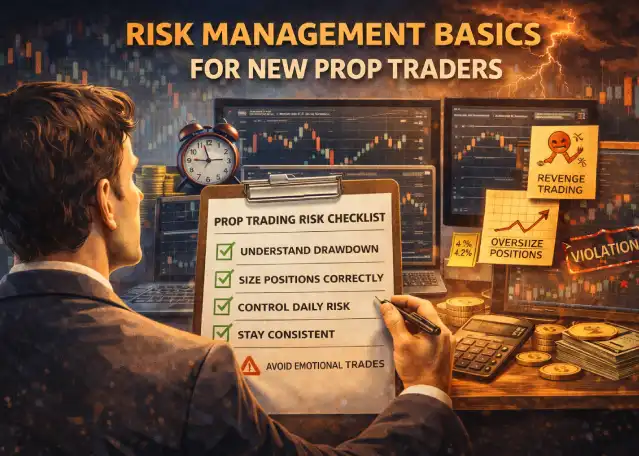
Final risk management checklist for new prop traders
- I fully understand all drawdown rules
- My position size cannot violate limits in one trade
- I risk less than I think I need to
- I do not increase risk after losses
- I stop trading before emotional decisions start
Bottom line
Risk management is what keeps you in the game long enough for skill to matter. In prop trading, survival always comes before profits.
Master risk control first—everything else comes after.
Related Articles
¿Cuál es la mejor regla de gestión del riesgo para los nuevos traders de prop trading?
Mantén el riesgo lo suficientemente bajo como para que una sola operación no pueda poner en peligro tu límite de pérdidas diario. Si un único error puede acabar con tu desafío, el tamaño de tu posición es demasiado grande.
¿Cuánto debería arriesgar por operación en una firma de prop trading?
No existe una cantidad universal, pero los nuevos traders de prop trading suelen obtener mejores resultados asumiendo un riesgo muy reducido. El objetivo es superar las rachas normales de pérdidas sin acercarse demasiado a los límites de drawdown. Si siente presión emocional por una sola operación, está arriesgando demasiado.
¿Por qué fracasan la mayoría de los traders de prop trading incluso con estrategias decentes?
Porque infringen las reglas. Las causas más comunes son operar con un tamaño excesivo, hacer trading de revancha e intentar «recuperarlo» rápidamente después de una pérdida.
¿Cómo puedo evitar superar el límite de drawdown diario?
Establece un límite personal de pérdida diaria más estricto que el de la empresa y deja de operar cuando lo alcances. Esto evita las decisiones emocionales y te mantiene alejado de cualquier posible incumplimiento.
¿Debería aumentar el riesgo cuando estoy cerca del objetivo de beneficios?
No. Aumentar el riesgo cerca del final de un desafío es una de las formas más habituales en que los traders fracasan. Es mejor aprobarlo poco a poco que fracasar rápidamente.
¿Cuáles son los hábitos más peligrosos para los nuevos traders de prop trading?
Apalancarse en exceso, cambiar el tamaño de la posición al azar, forzar operaciones cuando no existe una configuración válida y operar emocionalmente después de una racha de pérdidas. Si quieres un desglose claro de estos patrones, consulta Conductas de riesgo que provocan infracciones.
¿Necesito una estrategia diferente para el prop trading?
No necesariamente. Muchas estrategias funcionan, pero a menudo es necesario ajustar la configuración del riesgo. El prop trading recompensa una ejecución controlada y constante más que las rentabilidades agresivas.