




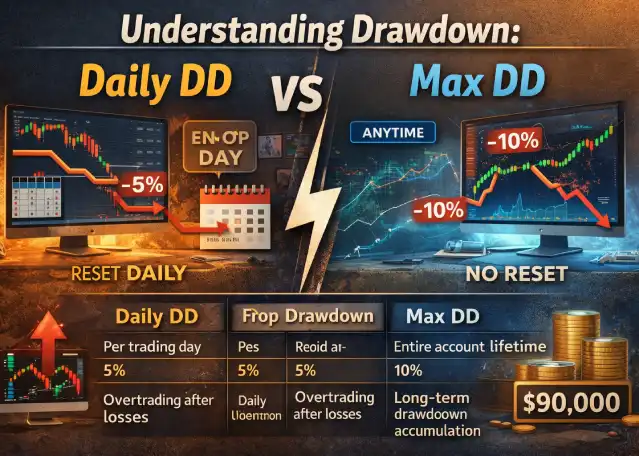
Understanding Drawdown: Daily DD vs Max DD
Drawdown rules are among the most important parts of prop trading. A trader can have a profitable strategy and still lose an evaluation or funded account because account equity crosses a daily or maximum loss threshold for only a brief moment.
The difficult part is that daily drawdown (daily DD) and maximum drawdown (max DD) are not calculated the same way at every prop firm. One program may use a fixed limit based on the initial account size, another may recalculate the daily threshold from the balance at the start of the day, and another may use a trailing maximum-loss level that rises as the account grows.
This guide explains the main drawdown models, how floating profit and loss can affect a breach, why reset times matter, how trailing drawdown works, and what traders should check before buying or trading a prop firm account.
What Is Drawdown in Prop Trading?
In general trading analysis, drawdown describes a decline from a previous peak in balance or equity. In prop trading, however, the word is also commonly used for the firm’s loss limits: the thresholds an account must not cross.
These limits can be based on:
- the initial account balance;
- the balance recorded at the start of the trading day;
- the highest balance reached at a specified calculation time;
- current equity;
- a trailing reference level;
- realized and unrealized P/L;
- commissions, swaps, and other trading costs.
A drawdown breach can occur even if the account later recovers. Many prop firms monitor the limit in real time, which means a temporary equity move below the permitted threshold may be enough to violate the rule.
That is why traders should not think of drawdown simply as “how much money I have lost.” The real question is:
What exact account value does the firm monitor, how is the limit calculated, and when is that limit recalculated?
Balance vs Equity: The First Drawdown Concept to Understand
Before comparing daily DD and max DD, traders need to understand the difference between balance and equity.
Balance
Account balance normally reflects the result of closed trades and completed account transactions. Floating profit or loss from currently open positions is not included in the balance until those positions are closed.
Equity
Equity reflects the current value of the account after open positions are included.
A simplified formula is:
Equity = Balance + Floating Profit/Loss − Trading Costs
Depending on the program, swaps, commissions, fees, and other costs may also form part of the calculation.
Why This Difference Matters
Imagine a $100,000 account with a $95,000 minimum permitted equity for the day.
- Closed-trade balance: $98,500
- Open floating loss: -$3,700
- Current equity: $94,800
The trader may look at the $98,500 balance and believe there is still room to trade. But if the firm monitors equity, the account has already fallen below the hypothetical $95,000 limit.
This is one of the most common reasons traders misunderstand prop firm drawdown rules.
What Is Daily Drawdown (Daily DD)?
Daily drawdown is a limit on how much the account can lose during a defined trading day or daily calculation period.
The rule is often called:
- Daily Drawdown;
- Daily Loss Limit;
- Maximum Daily Loss;
- Daily Loss;
- Daily Stop.
The name is less important than the formula behind it.
How Daily Drawdown Can Be Calculated
There is no universal daily drawdown formula. Common models include the following.
1. Fixed Daily Loss Amount Based on Initial Balance
A firm may define the daily loss amount as a percentage of the original account size.
Example:
- Initial account: $100,000
- Daily loss percentage: 5%
- Daily loss amount: $5,000
This tells you the size of the daily loss allowance, but it does not necessarily tell you the actual equity threshold. You still need to know what reference balance the firm uses for that day.
2. Daily Threshold Based on Start-of-Day Balance
Some programs calculate the minimum permitted equity from the balance recorded at a specified daily reset time.
Example:
- Initial account: $100,000
- Daily loss amount: $5,000
- Balance at daily reset: $102,000
The new hypothetical daily equity floor would be:
$102,000 − $5,000 = $97,000
In this model, profits closed before the reset can move the next day’s daily threshold upward. If the balance later falls, a future daily threshold may also move down, depending on the firm’s formula.
3. Daily Loss Measured From the Day’s Starting Position
Another approach tracks how much has been lost during the current day, combining closed and floating P/L. A profitable start to the day may temporarily increase the amount that can subsequently be lost while still remaining within the daily rule.
For example:
- Base daily loss allowance: $5,000
- Profit made earlier in the day: $2,000
- Maximum loss from the current intraday high under that specific model: potentially $7,000
This does not mean that every prop firm allows the same calculation. Always check the firm’s formula rather than assuming that daily profits create extra loss capacity.
What Does the Daily Drawdown Calculation Include?
Depending on the program, the calculation may include:
- closed trading losses;
- floating losses;
- floating profits;
- commissions;
- swaps or overnight financing;
- platform or exchange fees;
- other account adjustments.
This means a trader should never calculate daily DD using closed P/L alone unless the prop firm explicitly says that only realized results matter.
Daily Drawdown Reset Time
Daily drawdown normally resets or is recalculated once per trading day, but midnight is not the same moment for every firm.
The relevant time may be:
- midnight in the prop firm’s stated time zone;
- broker server midnight;
- New York close;
- Central European time;
- the futures session boundary;
- another program-specific reset point.
Daylight saving time can also move the reset relative to your local clock.
Before trading near the reset, identify the exact time used by the firm and convert it to your local time. Do not assume that your calendar date and the prop firm’s trading day are identical.
Why Overnight Positions Can Be Dangerous Around a Daily Reset
An overnight position can be inside the daily limit before the reset and outside the new limit immediately afterward.
Example:
- Balance at reset: $102,000
- New daily loss amount: $5,000
- New daily equity floor: $97,000
- Floating loss immediately after reset: -$5,200
- Current equity: $96,800
The account could breach the new daily threshold even though the trader did not open a new trade after the reset.
This is why holding positions overnight requires an understanding of both the firm’s holding policy and the exact daily DD recalculation method.
What Is Maximum Drawdown (Max DD)?
Maximum drawdown sets the lowest account value that may be reached over a broader account period. Unlike daily DD, it generally does not reset every day.
However, saying that maximum drawdown “never resets” is too simplistic. A program may reset or redefine the maximum-loss framework when a trader:
- passes from one evaluation phase to another;
- receives a new funded account;
- receives a replacement account after payout;
- resets or restarts the challenge;
- moves from simulated to live trading.
The correct rule is therefore the one attached to the trader’s current account stage.
Static Maximum Drawdown
A static max drawdown stays at the same monetary threshold during the relevant account stage.
Example:
- Initial account: $100,000
- Maximum loss: 10%
- Static minimum permitted equity: $90,000
If the account grows to $108,000, the static floor remains $90,000. The trader has created a larger cushion above the loss limit.
If equity later drops to $89,999 and the rule treats crossing $90,000 as a breach, the account fails even if balance remains above the threshold.
Trailing Maximum Drawdown
A trailing drawdown moves upward as the account reaches higher reference values. The limit usually never moves back down.
Example:
- Starting balance: $50,000
- Trailing loss distance: $2,000
- Starting loss floor: $48,000
If the relevant reference balance later rises to $50,500, the trailing floor might move to $48,500.
If the balance then falls, the loss floor may remain at $48,500 rather than moving back to $48,000.
This makes trailing drawdown more restrictive after profitable periods because part of the new profit effectively pulls the minimum account value upward.
Intraday Trailing vs End-of-Day Trailing Drawdown
Not all trailing limits move in the same way.
Intraday Trailing Drawdown
An intraday trailing limit can move upward when the monitored balance or equity reaches new highs during the trading session.
This can be particularly restrictive because an unrealized or short-lived profit may raise the loss floor before the day ends.
End-of-Day Trailing Drawdown
An end-of-day trailing limit updates only after the trading day closes or at another specified calculation point.
For example, a firm may monitor the limit in real time during the session but move the trailing threshold upward only after the end-of-day balance is recorded.
This distinction is critical. Two programs can advertise the same $2,000 maximum-loss distance while providing very different effective risk allowances.
Trailing Drawdown That Locks at a Level
Some trailing systems stop moving once the loss floor reaches a specified level, such as the initial account balance.
Example:
- Initial account: $50,000
- Starting trailing floor: $48,000
- Account grows until the trailing floor reaches $50,000
- Loss floor then locks at $50,000
Future profits can create a cushion above $50,000 without moving the threshold higher.
Other programs may continue trailing differently. Traders should check whether the drawdown:
- trails forever;
- stops at the starting balance;
- stops after a payout;
- resets after progression;
- uses balance or equity as the trailing reference.
Daily DD vs Max DD: Key Differences
| Aspect | Daily Drawdown | Maximum Drawdown |
|---|---|---|
| Purpose | Limits losses within one trading day or daily calculation period | Limits losses across the current account stage or trading cycle |
| Reset | Normally recalculated daily | Usually does not reset daily |
| Reference | May use initial balance, start-of-day balance, or daily P/L | May use initial balance, highest balance/equity, or trailing reference |
| Floating P/L | Often included | Often included |
| Common models | Fixed daily amount or start-of-day recalculation | Static, trailing, intraday trailing, end-of-day trailing |
| Main timing risk | Daily reset and overnight positions | New highs, trailing threshold movement, payouts |
Example: Daily DD and Max DD Working Together
Consider a hypothetical $100,000 account with:
- 5% daily loss allowance;
- 10% static maximum loss;
- daily threshold calculated from the balance at the reset;
- equity monitored continuously.
Day 1
- Starting balance: $100,000
- Daily floor: $95,000
- Maximum-loss floor: $90,000
The daily rule is currently more restrictive. Even though the max DD allows equity to fall as far as $90,000, the trader cannot fall below $95,000 during that day.
After a $4,000 Closed Profit
Suppose the trader ends the day at $104,000.
If the next daily floor is based on the new balance:
$104,000 − $5,000 = $99,000
The static max DD remains $90,000.
The trader therefore has:
- $5,000 of room before the hypothetical daily floor;
- $14,000 of room before the static max-loss floor.
Again, this is only an example. The exact formula varies by firm.
Example: Why Floating Loss Matters
Imagine:
- Daily floor: $97,000
- Current balance: $101,000
- Floating loss: -$3,500
- Equity: $97,500
The trader has only $500 of remaining equity room even though the closed balance is $4,000 above the threshold.
If the floating loss widens by another $600, equity becomes $96,900 and the daily rule may be breached.
Closing the position afterward at a better price would not undo a real-time breach if the firm monitors the threshold continuously.
Example: How a Trailing Max DD Changes After Profit
Consider:
- Starting account: $50,000
- Trailing loss distance: $2,000
- Starting floor: $48,000
After the relevant end-of-day balance reaches $51,500:
$51,500 − $2,000 = $49,500
The new trailing floor becomes $49,500.
If the account then loses $1,000 and closes at $50,500, the floor may remain at $49,500. The trader now has only $1,000 of remaining room rather than the original $2,000.
Why Profits Can Make a Drawdown Rule More Restrictive
Many beginners assume that making money always creates more room. That is true with a static loss floor, but not necessarily with a trailing model.
In a trailing account:
- profits can raise the reference balance;
- the drawdown floor can trail upward;
- subsequent losses may leave less room than expected;
- withdrawing profits may reduce the cushion further.
This is why traders should compare usable drawdown, not just the advertised account size.
Advertised Account Size vs Actual Risk Allowance
A $100,000 prop account does not mean the trader can lose $100,000.
If the account has:
- $100,000 nominal size;
- $5,000 daily loss allowance;
- $10,000 maximum loss allowance;
the practical risk limits are $5,000 for the daily framework and $10,000 for the overall framework, subject to the program’s exact calculation method.
The nominal account balance primarily affects position-sizing capacity and the percentage-based rules. It should not be confused with personal ownership of $100,000 in cash.
For more on this distinction, see What Is a Funded Account in Prop Trading?.
What Happens to Drawdown After a Payout?
Payouts can have a major effect on remaining drawdown room.
Possible models include:
- the loss floor remains unchanged while balance falls after the payout;
- the trailing calculation stops at a fixed level;
- the account receives a new balance or new drawdown framework;
- a new funded account is issued;
- available drawdown is recalculated under payout-specific rules.
Example:
- Balance before payout: $108,000
- Loss floor: $100,000
- Payout: $6,000
- Post-payout balance: $102,000
If the loss floor remains $100,000, the trader has only $2,000 of remaining room after the payout.
This is why the maximum available payout is not always the amount a trader should withdraw. Before requesting a payout, calculate the post-payout balance and the resulting cushion above every relevant loss threshold.
Common Drawdown Mistakes Traders Make
1. Watching Balance Instead of Equity
A profitable-looking balance can hide a large floating loss. If equity is the monitored value, the account can breach before the losing position is closed.
2. Assuming Every 5% Daily DD Works the Same Way
The percentage alone is not enough. You need to know:
- 5% of what?
- measured from which balance?
- at what reset time?
- including which costs?
- monitored using balance or equity?
3. Forgetting the Daily Reset
A position safe before the reset may become unsafe immediately afterward when the new daily threshold is calculated.
4. Confusing Static and Trailing Drawdown
A static floor gives the trader more cushion as profits grow. A trailing floor may move upward with those profits and preserve much less room.
5. Ignoring Intraday vs End-of-Day Trailing
If the drawdown trails intraday, a temporary profit can raise the threshold. If it trails end-of-day, intraday highs may not affect the limit until the specified calculation time.
6. Risking the Entire Remaining Daily Allowance
Trading right up to the firm’s limit leaves no room for:
- slippage;
- spread widening;
- commissions;
- swaps;
- additional correlated exposure;
- rapid market movement.
7. Increasing Size After Losses
Trying to recover quickly can turn a manageable drawdown into a rule breach. This behaviour becomes even more dangerous when the account is close to both the daily and maximum limits.
8. Ignoring Correlated Positions
Several trades can represent the same underlying risk.
For example, long EUR/USD, long GBP/USD, and short USD/CHF may all create significant exposure to a weaker U.S. dollar. A single market move can therefore affect several positions at once.
9. Treating Stop-Loss Distance as the Only Risk
During fast markets, execution may occur beyond the stop level. News events can also widen spreads and increase floating loss. See News Trading Rules: Why They Exist & How to Avoid Violations for additional event-risk considerations.
10. Withdrawing Too Much Profit
A payout can reduce the cushion between the account balance and the drawdown threshold. Traders should calculate the post-payout risk allowance before requesting the maximum available amount.
How to Calculate Your Remaining Drawdown Room
Once the prop firm provides the current threshold, a simple practical calculation is:
Remaining Drawdown Room = Current Equity − Current Loss Floor
Example:
- Current equity: $101,600
- Current daily floor: $98,000
- Current maximum-loss floor: $94,000
Remaining daily room:
$101,600 − $98,000 = $3,600
Remaining maximum-loss room:
$101,600 − $94,000 = $7,600
The daily limit is currently the binding constraint because it leaves less room.
Do not risk the entire $3,600. A safer plan normally keeps a buffer for execution costs and unexpected volatility.
How to Trade More Safely Within Drawdown Limits
Set a Personal Daily Stop Below the Firm Limit
If the firm allows a 5% daily loss, your personal daily stop does not need to be 5%.
A trader might choose to stop much earlier so that a bad session never approaches the contractual threshold.
The correct personal limit depends on the strategy, but the principle is simple:
The prop firm’s drawdown limit should be the emergency boundary, not the normal amount you plan to risk.
Define Risk Per Trade From the Remaining Cushion
A fixed percentage such as 0.25% or 0.5% can be useful, but it should not be applied mechanically.
Consider:
- remaining daily drawdown;
- remaining maximum drawdown;
- number of simultaneous positions;
- correlation between positions;
- stop distance;
- instrument volatility;
- news risk.
Use Stop-Loss Orders, but Allow for Execution Risk
A stop-loss can define planned risk, but it does not guarantee the exact exit price during every market condition.
Keep enough buffer so that moderate slippage does not immediately turn a planned loss into a prop firm breach.
Reduce Risk During a Losing Streak
After several losses, the account has less room above the maximum-loss threshold. Continuing to use the same monetary risk can consume an increasingly large share of the remaining cushion.
Reducing size after drawdown can extend the number of trades available for the strategy to recover.
Check Equity Before Opening Another Trade
Before adding exposure, review:
- current balance;
- current equity;
- floating P/L;
- current daily loss floor;
- current max-loss floor;
- remaining room to each limit.
Know the Reset Time Before Holding Overnight
If positions remain open across the daily reset, calculate what the new daily floor will be and whether the current floating P/L would still be safe afterward.
Leave Additional Room Before High-Impact News
Spread expansion and slippage can cause equity to change faster than expected. A trader already close to the drawdown boundary has very little tolerance for execution surprises.
What to Check Before Buying a Prop Firm Account
Do not compare programs using only the headline percentages. Before paying for a prop firm challenge, answer all of the following.
Daily Drawdown
- What is the daily loss percentage or amount?
- What balance is used as the reference?
- Does the calculation include floating P/L?
- Are commissions, swaps, and fees included?
- When is the daily threshold recalculated?
- Which time zone or server time is used?
- Does closed profit increase the day’s available loss allowance?
- Can the next day’s threshold move up or down?
Maximum Drawdown
- Is the maximum loss static or trailing?
- Does it trail balance or equity?
- Does it trail intraday or end-of-day?
- Can the threshold ever move down?
- Does it stop trailing at the initial balance?
- What happens after a payout?
- Does it reset after passing a phase?
- Is the same rule used on the funded account?
Breach Conditions
- Does touching the threshold cause a breach, or only moving below it?
- Is the rule monitored in real time?
- What happens after a breach?
- Is the account permanently closed?
- Can the challenge be reset or restarted?
The exact wording matters. A rule stating that equity must remain above $95,000 can be different from one stating that it must not fall below $95,000, depending on how the boundary itself is treated.
Drawdown Rules Can Change Between Programs
The same prop firm may offer several account models with different daily and maximum loss structures.
Differences can include:
- one-step vs two-step evaluations;
- forex/CFD vs futures programs;
- simulated funded vs live accounts;
- new vs legacy account plans;
- optional daily loss controls;
- different trailing models;
- different payout rules.
Do not rely on an old review, a social-media post, or another trader’s account. Check the current rules for the exact program and purchase date.
Daily DD vs Max DD: Which One Should You Watch More Closely?
Both matter, but the tighter limit at any particular moment should receive the most attention.
If the account has:
- $2,000 of remaining daily room; and
- $7,000 of remaining max-DD room;
the daily rule is currently more restrictive.
After the next reset, the relationship could change. On a trailing account, a profitable day can also move the maximum-loss floor upward.
A useful habit is to track both thresholds together rather than treating them as separate concepts.
Final Thoughts
Daily drawdown and maximum drawdown are not simply two percentages printed in a prop firm’s rules. Their real impact depends on the calculation method.
Daily DD may be based on the initial balance, the balance at a daily reset, or current daily P/L. Max DD may be static, intraday trailing, end-of-day trailing, or designed to stop trailing at a particular level. Both may include floating P/L, commissions, swaps, and other costs.
The safest approach is to identify the current loss floor rather than thinking only in percentages. Know the value your equity must stay above, know when that value changes, and keep a personal risk buffer well before the official breach level.
Before trading any prop account, confirm the exact drawdown formula for the specific program, stage, and account type. Doing that is just as important as understanding the profit target, payout rules, and trading restrictions.
Related Articles
¿Qué es el drawdown en el trading propietario?
En el prop trading, el drawdown generalmente se refiere al importe que puede disminuir una cuenta antes de alcanzar el límite de pérdidas establecido por la empresa de prop trading.
El aspecto importante es que la empresa puede calcular este límite utilizando el saldo, el capital, las pérdidas y ganancias flotantes, o una combinación de estos valores. Por lo tanto, los traders deben comprobar la fórmula exacta en lugar de basarse únicamente en el porcentaje anunciado.
¿Qué es el drawdown diario?
La reducción máxima diaria, también denominada límite de pérdida diaria o pérdida diaria máxima, limita cuánto puede perder la cuenta durante una jornada de trading o un periodo de cálculo diario.
El umbral normalmente se recalcula una vez al día, pero la hora exacta de reinicio y la fórmula dependen de la firma de fondeo.
¿Qué es el drawdown máximo?
La pérdida máxima establece el límite general de pérdidas de la cuenta o de la fase de trading actual.
A diferencia de la pérdida diaria, normalmente no se restablece cada día. Puede ser estática, lo que significa que el límite de pérdidas permanece fijo, o dinámica, lo que significa que el límite aumenta a medida que la cuenta alcanza valores más altos.
¿Cuál es la diferencia entre el DD diario y el DD máximo?
El DD diario controla cuánto se puede perder durante una sola jornada de trading, mientras que el DD máximo controla hasta qué punto puede caer la cuenta durante el periodo total de la cuenta.
El trader debe mantenerse dentro de ambos límites al mismo tiempo. Normalmente, el límite más estricto constituye la restricción de riesgo inmediata.
¿El drawdown se calcula a partir del saldo o del equity?
Depende de la empresa de trading propietario y del programa.
Muchas empresas supervisan el equity, lo que significa que las ganancias y pérdidas flotantes pueden afectar al cálculo del drawdown antes de cerrar una posición. Otros cálculos pueden utilizar el balance como referencia para establecer el límite mínimo de pérdidas, mientras siguen supervisando el equity actual frente a ese umbral.
¿Cuál es la diferencia entre el drawdown dinámico intradía y el drawdown dinámico al final del día?
El drawdown dinámico intradía puede aumentar a medida que se alcanzan nuevos máximos del balance o del capital durante la sesión de trading.
El drawdown dinámico al cierre del día se actualiza utilizando un valor registrado al final de la jornada de trading o en otro momento de cálculo especificado.
Esta diferencia puede hacer que dos cuentas con el mismo importe de drawdown anunciado se comporten de manera muy distinta.
¿Puede una operación abierta durante la noche provocar un incumplimiento del drawdown diario después del reinicio?
Sí. Una posición puede encontrarse dentro del límite permitido antes del reinicio diario, pero quedar fuera del nuevo límite calculado inmediatamente después.
Esto puede ocurrir cuando cambia el límite de pérdida diaria y la cuenta ya registra una pérdida flotante.
¿Cómo calculo el margen de drawdown que me queda?
Un cálculo simplificado útil es:
Margen de drawdown restante = Patrimonio actual − Límite de pérdida actual
Por ejemplo, si el patrimonio actual es de $101,500 y el límite de pérdida activo es de $98,000, el margen restante es de $3,500.
Esto no significa que el trader deba arriesgar los $3,500 completos. Normalmente, debe mantenerse un margen de seguridad adicional para cubrir el deslizamiento, los spreads, las comisiones
¿Qué es más importante: el DD diario o el DD máximo?
Ambos deben respetarse.
En cada momento, el límite más importante suele ser el que deja el colchón restante más pequeño. Por ejemplo, si el trader dispone de un margen diario de 2.000 $ pero de 7.000 $ antes de alcanzar la pérdida máxima, el límite diario es actualmente la restricción más exigente.